
Most british and American investors searching for lasting legacy assets are discovering a shift in priorities for 2025. With demand for ultra-prime European real estate projected to climb by nearly 15 percent, Italy stands out for those seeking security and long-term value. This article reveals how choosing the right luxury property in Italy can offer generational stability, cultural richness, and a genuine strategic foothold for high-net-worth families.
Table of Contents
- What Buying in Italy Truly Means
- Types of Italian Luxury Properties
- Residency, Citizenship, and Buyer Rights
- Costs, Taxes, and Legal Considerations
- Comparing Italy to Other Luxury Markets
Key Takeaways
| Point | Details |
|---|---|
| Investment Potential | Buying in Italy offers access to generational wealth and a diverse real estate market with unique lifestyle investments. |
| Luxury Property Categories | Italian luxury properties vary from historic mansions to coastal villas, each category having specific tax implications and potential for appreciation. |
| Legal Considerations | Foreign property buyers must navigate complex ownership laws and potential residency pathways, engaging legal experts is crucial. |
| Market Comparison | Italy’s luxury market presents competitive pricing and cultural value compared to other high-end European markets, ensuring long-term investment stability. |
What Buying in Italy Truly Means
Buying in Italy transcends a mere property transaction. It represents a sophisticated gateway to generational wealth, cultural immersion, and strategic financial positioning within Europe’s most nuanced real estate landscape. Investing in Italy opens access to a dynamic, innovation-driven economy that provides far more than bricks and mortar—it offers a comprehensive lifestyle investment.
The Italian property market represents an intricate tapestry of opportunities spanning historic urban centres, picturesque coastal regions, and agricultural estates. Investors gain entry into a market characterised by profound cultural heritage and economic resilience. Italy’s diversified economy excels across multiple sectors—from traditional ‘Made in Italy’ luxury goods to advanced technological industries like aerospace and pharmaceuticals—creating multiple pathways for wealth generation and strategic asset positioning.

Understanding the Italian property ecosystem requires recognising its multifaceted nature. Potential buyers can leverage opportunities across residential, commercial, and agricultural real estate segments, each offering unique advantages. The government actively supports foreign direct investment through streamlined administrative procedures, tax incentives, and robust legal frameworks designed to attract international capital.
Professional Insight: Research regional variations in property laws, tax structures, and local market dynamics before making investment decisions, as nuances can significantly impact your long-term returns.
Types of Italian Luxury Properties
Italian luxury properties represent a sophisticated spectrum of real estate investments, ranging from historic architectural marvels to contemporary masterpieces. Luxury properties are officially defined by specific ministerial criteria that go beyond mere size and price, encompassing historical significance, architectural integrity, and unique geographical positioning.
The primary categories of Italian luxury properties include:
- Stately Apartments: Urban residences in historic city centres with exceptional architectural features
- Historic Mansions: Grand estates with significant cultural and architectural heritage
- Castles and Palaces: Properties classified under the prestigious A/9 category, representing ultimate luxury
- Coastal Villas: Exclusive properties with stunning Mediterranean views and expansive land plots
- Restored Agricultural Estates: Renovated farmhouses in Tuscany, Umbria, and other picturesque regions
Legal definitions of luxury real estate extend beyond physical characteristics, considering factors such as location prestige, architectural uniqueness, and potential for historical preservation. Each property category carries specific tax implications and potential residency benefits, making them attractive for high-net-worth international investors seeking more than just a residential asset.
The following table summarises the main categories of Italian luxury properties and their unique investment potential:
| Property Category | Location Examples | Key Investment Value |
|---|---|---|
| Stately Apartments | Rome, Florence | Central, historic prestige |
| Historic Mansions | Lake Como, Venice | Cultural heritage, rare assets |
| Castles and Palaces | Turin, Siena | Exceptional status, preservation |
| Coastal Villas | Amalfi Coast, Sardinia | Scenic views, high rental demand |
| Restored Agricultural Estates | Tuscany, Umbria | Countryside charm, agritourism |
Professional Insight: Consult specialised Italian real estate attorneys to navigate the complex legal classifications and potential tax advantages associated with different luxury property categories.
Residency, Citizenship, and Buyer Rights
Italian property ownership for foreigners involves a complex legal framework that carefully balances international investment opportunities with national regulatory requirements. While property acquisition does not automatically confer residency or citizenship rights, strategic investors can navigate multiple pathways to establish a legal presence in Italy.
Foreign buyers must understand the distinct legal categories governing property ownership and immigration status:
- EU Citizens: Enjoy most straightforward property acquisition and residency processes
- Non-EU Investors: Require specific visa categories and must meet additional documentation requirements
- Investor Visa Programme: Offers accelerated residency track for substantial financial investments
- Reciprocity Agreements: Determine property ownership rights based on bilateral international treaties
Foreigners may purchase property in Italy regardless of residency status, provided they comply with specific legal frameworks. The acquisition process requires thorough documentation, proof of financial stability, and adherence to immigration regulations. While property ownership does not guarantee automatic residency, strategic investors can leverage specific visa programmes that facilitate long-term settlement and potential citizenship pathways.
Professional Insight: Engage specialised immigration lawyers who understand the intricate connections between property investment, residency applications, and citizenship requirements to ensure a smooth and legally compliant transition.
Costs, Taxes, and Legal Considerations
Foreign buyers in Italy must navigate a complex financial landscape involving multiple layers of taxation, legal fees, and transactional expenses. The Italian property acquisition process demands meticulous financial planning, with costs extending far beyond the initial purchase price.
Key financial components for property investors include:
- Registration Tax: Ranging from 2% to 9% depending on property type
- Notary Fees: Typically 1–2% of property value
- Estate Agent Commissions: Usually 3–5% of transaction value
- Legal Documentation Costs: Including translation and administrative processing
- VAT Considerations: Different rates for new constructions versus resale properties
The taxation framework in Italy distinguishes between primary residences and secondary properties, with significant implications for tax liability. Luxury property investors must carefully consider the cadastral value assessment, which often differs from market transaction prices. Strategic financial planning involves understanding these nuanced tax mechanisms, potential exemptions, and the intricate relationship between property ownership and fiscal obligations.
Professional Insight: Engage a specialised Italian tax consultant who understands the complex interplay between property classification, ownership status, and potential tax incentives to optimise your investment strategy.
Comparing Italy to Other Luxury Markets
Italy’s luxury property market stands as a compelling investment landscape, offering unique advantages compared to other global luxury real estate destinations. While markets like Monaco, London, and Dubai attract significant attention, Italian properties present a nuanced value proposition that extends beyond mere transactional value.
Key comparative advantages of the Italian luxury market include:
- Price Resilience: More competitive pricing compared to other European luxury markets
- Cultural Heritage: Unparalleled historical and architectural significance
- Lifestyle Appeal: Exceptional quality of life across multiple regions
- Investment Stability: Steady appreciation in prime locations like Milan and Florence
- Geographical Diversity: From coastal retreats to mountain estates
The strategic positioning of Italian luxury real estate is further enhanced by its competitive pricing and extraordinary lifestyle offerings. Unlike more saturated markets, Italy provides high-net-worth investors with opportunities for substantial long-term value appreciation, coupled with an immersive cultural experience that transcends typical property investment paradigms. Cities such as Portofino, Lucca, and Milan continue to demonstrate robust performance in the global luxury property ecosystem.
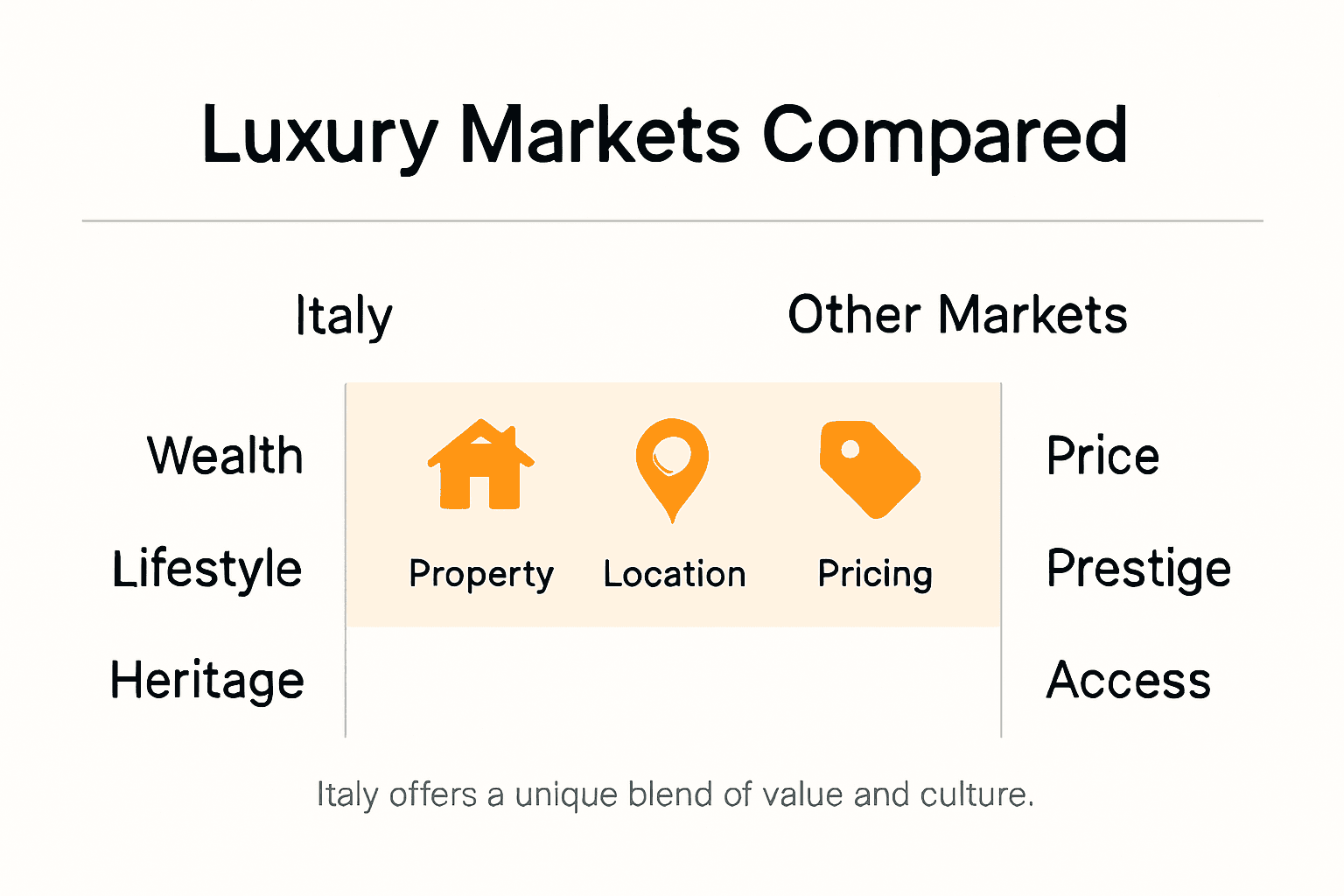
Here is a concise comparison of luxury property purchase costs in Italy versus other prime European markets:
| Market | Entry Price Range | Key Additional Costs | Investor Appeal |
|---|---|---|---|
| Italy | €500k–€5M+ | Moderate taxes, legal fees | Cultural value, price stability |
| London | £1M–£20M+ | High stamp duty, agent fees | Financial hub, strong demand |
| Monaco | €2M–€50M+ | Low taxes, service fees | Tax haven, exclusivity |
| Paris | €1M–€15M+ | Notary, capital gains taxes | Artistic lifestyle, demand |
Professional Insight: Conduct thorough comparative market analysis across multiple European destinations, focusing on long-term appreciation potential and lifestyle factors beyond immediate financial returns.
Elevate Your Legacy by Bridging Italy’s Wealth Wisdom with Côte d’Azur Elegance
The journey of acquiring property in Italy is much more than a purchase it is a strategic step towards generational wealth, lifestyle enrichment, and cultural legacy. If you are inspired by Italy’s rich heritage of luxury estates, historic mansions, and coastal villas, next consider the vibrant French Riviera where similar principles of timeless value, strategic investment, and lifestyle allure converge. Just as Italian luxury properties promise deep cultural roots and diversified returns, the Côte d’Azur offers high-net-worth visionaries an unmatched blend of eco-luxury, prime locations from Cap d’Antibes to Saint-Tropez, and an environment that elevates your investment into a family heirloom.
Whether seeking exquisite sea-view villas with enduring legal and fiscal safeguards or pioneering sustainable new builds that promise both lifestyle pleasure and financial resilience, understanding the nuances of property laws, tax regimes, and residency rights is critical. At Living on the Côte d’Azur we specialise in turning these complexities into clear opportunities, guiding visionary buyers. Explore how you can combine Italy’s captivating real estate inheritance with Riviera sophistication by connecting with experts who appreciate the subtle dynamics of cross-border legacy investments. Discover tailored insights on securing your place within the elite circle of luxury property owners who value both innovation and heritage.
Are you ready to transform your aspiration of owning prime Mediterranean real estate into a lasting legacy for generations? Start by reaching out to the team at Living on the Côte d’Azur for personalised guidance that respects your unique goals. Unlock the synergy between Italy’s wealth-building wisdom and the French Riviera’s unparalleled lifestyle. Act now to benefit from the buoyant 2025 market trends and transform your vision into an enduring seaside sanctuary. Your heirloom awaits.
Frequently Asked Questions
What are the benefits of buying property in Italy?
Buying property in Italy provides access to generational wealth, cultural immersion, and potential residency options. It offers a sophisticated lifestyle investment in a diverse real estate market renowned for its historical significance and economic resilience.
How does the Italian luxury property market compare to other luxury markets?
Italy’s luxury property market offers relatively competitive pricing, unparalleled cultural heritage, and a high quality of life. Compared to markets like London, Monaco, and Paris, Italy provides substantial long-term appreciation potential while offering unique lifestyle experiences beyond just financial returns.
What are the key financial considerations when purchasing property in Italy?
Key financial factors include registration tax (2% to 9%), notary fees (1–2%), estate agent commissions (3–5%), and legal documentation costs. It’s essential to understand the taxation framework and potential exemptions related to primary and secondary properties to optimise your investment.
Do foreign buyers have the right to purchase property in Italy?
Yes, foreign buyers can purchase property in Italy regardless of their residency status, provided they comply with specific legal requirements. EU citizens generally enjoy a more straightforward acquisition process, while non-EU investors may need to apply for specific visas and follow additional documentation procedures.
Recommended
 //
//