
Most advice about property valuation overlooks how easily british and international investors can misjudge a Côte d’Azur estate’s true worth. Over 60 percent of luxury property owners admit confusion over key valuation methods and legal nuances. For those planning generational legacy investment, clarity is essential to avoid costly oversights. This guide demystifies property valuation complexities, exposes common misconceptions, and highlights the expert strategies behind sustainable luxury asset selection.
Table of Contents
- Property Valuation Defined And Misconceptions
- Major Types Of Valuation Methods
- Factors Influencing Luxury Asset Values
- French Legal Framework And Compliance
- Financial Impacts And Common Pitfalls
Key Takeaways
| Point | Details |
|---|---|
| Understanding Property Valuation | Property valuation is a dynamic process influenced by various economic and market factors; it is not a fixed figure. |
| Valuation Methods | Recognising different valuation methods, such as Comparable Sales and Income Capitalisation, is essential for precise property assessment. |
| Luxury Asset Dynamics | Luxury real estate value is affected by unique elements including geographical positioning and experiential value, requiring a nuanced valuation approach. |
| Legal Framework in France | Navigating property investments in France necessitates understanding local regulations and engaging specialists for compliance and legal security. |
Property valuation defined and misconceptions
Property valuation is a sophisticated process of estimating the monetary worth of real estate through systematic professional analysis. Understanding this concept requires moving beyond simplistic assumptions about property pricing.
At its core, property valuation represents professional market value estimation, involving complex economic principles that determine a property’s potential market price. Key factors influencing valuation include:
- Location characteristics
- Property condition
- Current market demand
- Comparable recent sales
- Potential future developments
Common misconceptions often undermine accurate property assessment. Many individuals erroneously believe valuation provides an absolute, unchanging figure. However, property valuation principles reveal it as a dynamic process influenced by numerous variables, including:
- Economic fluctuations
- Local infrastructure changes
- Neighbourhood transformation
- Broader regional development trends
Professional valuers employ multiple methodological approaches, recognising that no single technique guarantees perfect precision. They integrate comparative market analysis, income approach techniques, and replacement cost methods to generate comprehensive property assessments.
Pro tip: Always request a detailed valuation report that explains the methodology used, highlighting assumptions and potential market variables affecting the estimated value.
Major types of valuation methods
Property valuation comprises several sophisticated methodological approaches designed to estimate real estate worth with precision and professional insight. Understanding these standard valuation techniques enables investors and property professionals to make informed decisions across diverse market scenarios.
The primary valuation methods include:
Comparable Sales Method
- Analyses recent sales of similar properties
- Considers location, size, condition, and features
- Most reliable when robust sales evidence exists
Income Capitalisation Method
- Applies to income-generating properties
- Calculates value based on potential rental income
- Involves assessing net operating income and capitalisation rates
Cost Approach Method
- Evaluates property based on reconstruction or replacement costs
- Accounts for land value and depreciation
- Particularly useful for unique or specialised properties
Residual Method
- Estimates property value by calculating potential development profit
- Subtracts development costs from projected sale or rental value
- Commonly used in property development and investment scenarios
International Valuation Standards emphasise that professional valuers must select methods strategically. The choice depends on property type, available data, market conditions, and specific valuation objectives.
Each method offers unique insights, with professional valuers often employing multiple approaches to generate comprehensive and accurate property assessments. This multifaceted approach helps mitigate individual method limitations and provides a more robust valuation.
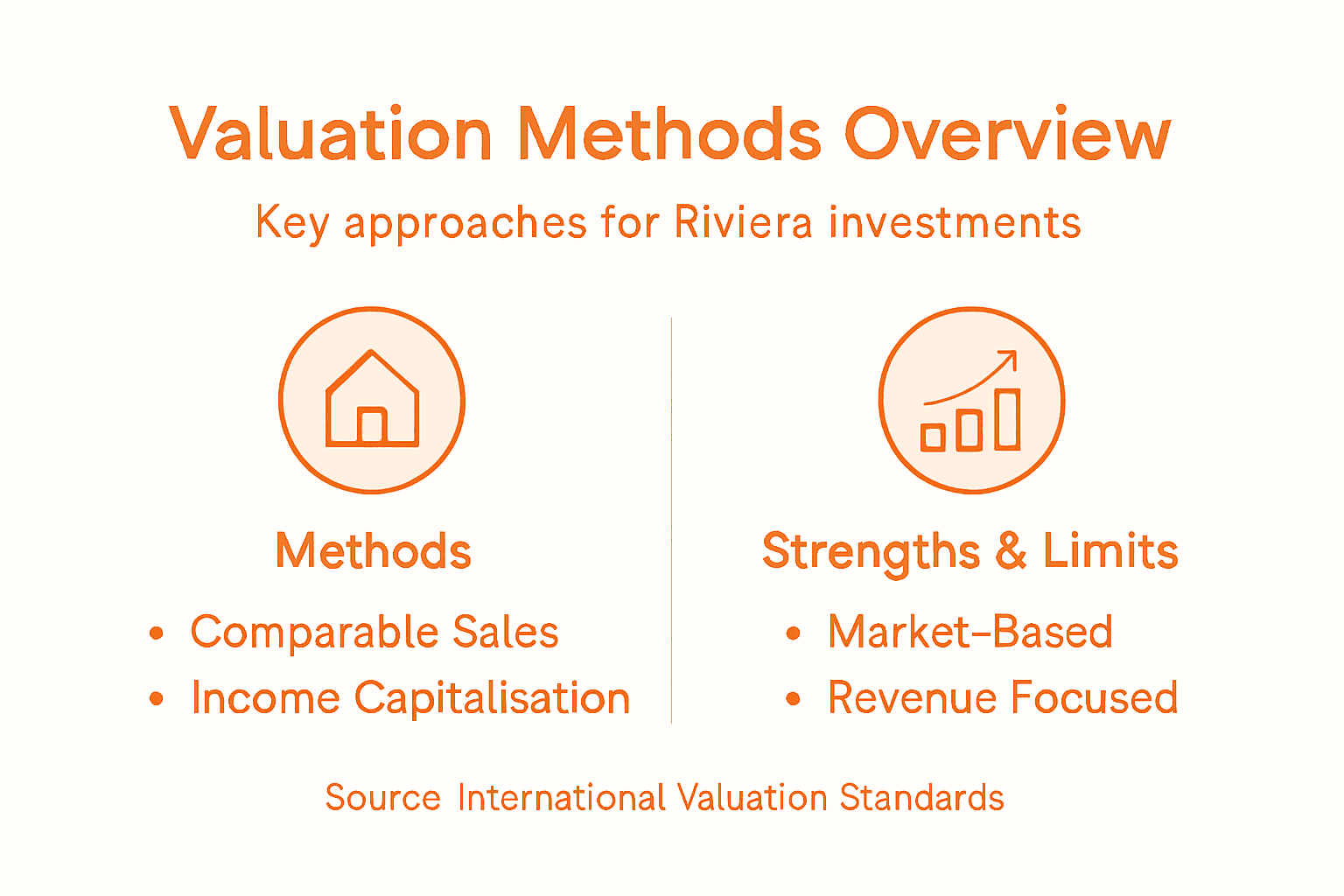
The table below compares major property valuation methods, providing insight into their ideal application and limitations:
| Valuation Method | Best Used For | Main Strength | Key Limitation |
|---|---|---|---|
| Comparable Sales | Residential sales and robust markets | Reflects current market sentiment | Relies on available data |
| Income Capitalisation | Investment properties | Focuses on potential returns | Sensitive to rent fluctuations |
| Cost Approach | Unique or new builds | Useful when little sales evidence | May not reflect market desirability |
| Residual Method | Development land | Accounts for future project profitability | Complex cost and revenue estimates |
Pro tip: Request valuations that incorporate at least two different methodological approaches to ensure a more comprehensive and reliable property assessment.
Factors influencing luxury asset values
Luxury real estate investments represent far more than traditional property acquisitions, embodying a complex interplay of economic, social, and experiential elements. Luxury asset dynamics reveal a sophisticated landscape where value transcends mere physical characteristics.
Key factors influencing luxury asset values include:
Geographical Positioning
- Proximity to prestigious locations
- Unobstructed panoramic views
- Exclusive neighbourhood reputation
- Access to high-end amenities
Architectural Significance
- Unique design elements
- Historical or architectural heritage
- Innovative technological integrations
- Quality of construction materials
Lifestyle and Experiential Value
- Potential for memorable experiences
- Cultural and recreational opportunities
- Privacy and security features
- Potential for personalisation
Economic and Market Factors
- Regional economic stability
- International investment trends
- Currency exchange dynamics
- Local and global market sentiment
The Côte d’Azur represents a microcosm of luxury asset valuation, where high-end property appreciation intertwines with lifestyle, prestige, and investment potential. Discerning investors recognise that true value extends beyond physical boundaries, encompassing cultural capital, potential for generational wealth transfer, and the intangible allure of exceptional real estate.
Modern luxury asset evaluation increasingly emphasises sustainability, technological integration, and adaptability. Properties that demonstrate environmental consciousness, smart home technologies, and flexible living spaces command premium valuations in the contemporary market.
Pro tip: Conduct comprehensive due diligence that evaluates not just the property’s current value, but its potential for future appreciation and lifestyle enhancement.
French legal framework and compliance
Navigating the French real estate landscape requires a comprehensive understanding of the intricate legal regulatory framework governing property transactions. The French legal system provides robust protections and clear guidelines for international investors seeking to acquire luxury properties along the Côte d’Azur.
Key legal considerations for property investors include:
Property Ownership Regulations
- Clear title verification process
- Restrictions on foreign ownership
- Inheritance and succession laws
- Tax implications for non-resident investors
Transaction Compliance
- Mandatory involvement of licensed notaries
- Comprehensive property disclosure requirements
- Standardised purchase agreement protocols
- Legal protections for both buyers and sellers
Taxation Framework
- Progressive property transfer taxes
- Capital gains tax regulations
- Wealth tax considerations
- Special provisions for luxury real estate
Regulatory Oversight
- Urban planning restrictions
- Environmental compliance standards
- Building and renovation permit processes
- Conservation area regulations
Real estate legal complexities demand meticulous attention to detail. The French Civil Code, supplemented by specific real estate regulations, creates a structured environment that balances investor interests with robust national protections.

International investors must recognise that French property law prioritises transparency, legal certainty, and comprehensive documentation. The notarial system ensures rigorous verification of property history, legal status, and potential encumbrances, providing an additional layer of security for high-value transactions.
Pro tip: Engage a bilingual legal specialist with specific expertise in French property law to navigate the complex regulatory landscape and ensure full compliance with local regulations.
Financial impacts and common pitfalls
Property investment in the Côte d’Azur requires sophisticated financial understanding, with property valuation intricacies presenting complex challenges for international investors. The financial landscape demands nuanced comprehension beyond superficial market assessments.
Key financial considerations and potential pitfalls include:
Valuation Risk Factors
- Market cyclical fluctuations
- Currency exchange volatility
- Comparative market analysis limitations
- Potential overvaluation scenarios
Investment Performance Challenges
- Unpredictable rental market dynamics
- Maintenance and renovation costs
- Tax compliance complexities
- Long-term appreciation uncertainty
Financing Obstacles
- Non-resident lending restrictions
- Higher interest rates
- Stringent documentation requirements
- Limited mortgage options
Structural Financial Risks
- Property liquidity challenges
- Inheritance and wealth transfer complications
- International tax treaty implications
- Potential legal and regulatory shifts
Professional valuation strategies recommend comprehensive due diligence to mitigate potential financial vulnerabilities. Sophisticated investors recognise that successful Riviera property investments require detailed financial modelling, understanding local market nuances, and maintaining flexibility in strategic approach.
The most successful investors adopt a holistic perspective, considering not just immediate financial metrics but long-term generational wealth potential. This approach demands continuous market research, professional financial consultation, and a willingness to adapt investment strategies in response to evolving economic landscapes.
The following table summarises common financial pitfalls in Côte d’Azur property investment, alongside recommended strategies for mitigation:
| Financial Pitfall | Description | Mitigation Strategy |
|---|---|---|
| Market Volatility | Rapid price swings impact valuations | Conduct scenario planning |
| Currency Fluctuations | Exchange rate risks affect foreign buyers | Use currency hedging tools |
| Limited Mortgage Options | Fewer loans for non-residents | Consult international lenders |
| Tax Complexity | Multiple tax obligations for investors | Hire a qualified tax advisor |
Pro tip: Develop a comprehensive financial model that incorporates multiple scenario analyses, accounting for potential market volatilities and unexpected regulatory changes.
Unlock the Full Potential of Your Riviera Investment with Expert Property Valuation Support
Understanding property valuation is essential for navigating the intricate French Riviera real estate market. Whether it is deciphering valuation methods like Comparable Sales or Residual approaches, or grappling with factors such as luxury asset characteristics and the unique French legal framework, astute investors need comprehensive insight and tailored guidance. Accurate valuations help you avoid overpaying, identify future appreciation opportunities, and structure financial and legal arrangements that protect your investment in this prestigious region.
At Living on the Côte d’Azur, we bridge the gap between complex valuation principles and your dream of acquiring a true legacy asset. Our expert team specialises in clarifying valuation impacts on Riviera investments—from rigorous legal audits to nuanced financial forecasting and strategic market positioning. Discover how to mitigate common pitfalls and harness the true value of luxury villas French Riviera 2025 with personalised advice crafted for discerning buyers.
Explore our expertise further and connect with professionals who understand every aspect of luxury property acquisition by visiting Contact Nice to Meet You. Ready to unlock your gateway to French Riviera paradise and secure an heirloom estate with confidence? Contact us today to start your journey towards an intelligent, informed investment.
Frequently Asked Questions
What is property valuation?
Property valuation is the process of estimating the monetary worth of real estate through systematic professional analysis, considering various factors such as location, property condition, market demand, and recent sales.
What methods are commonly used for property valuation?
The main methods include the Comparable Sales Method, Income Capitalisation Method, Cost Approach Method, and Residual Method, each designed to provide insights based on different aspects of real estate valuation.
How do economic factors influence property values?
Economic fluctuations, local infrastructure changes, and broader regional development trends significantly impact property values, as they shape market demand and investment potential over time.
What are some common pitfalls in property investment?
Common pitfalls include market volatility, currency fluctuations, limited mortgage options for non-residents, and complex tax obligations. It is crucial to conduct comprehensive due diligence to mitigate these financial risks.
Recommended
 //
//