The tramlines in Nice French Riviera represent a crucial component of the city’s public transportation infrastructure. With three fully operational lines and two more in the planning stages, the tram network is set to expand significantly in the coming years. These developments are aligned with Nice’s goals of promoting sustainable urban mobility, reducing traffic congestion, and enhancing the quality of life for its residents. As the city continues to grow and evolve, its tram system will undoubtedly play a key role in shaping its future. For buyers of a property in the Nice area, this is great news.
Tramlines in Nice, Côte d’Azur: today and future stops
The city of Nice, located on the French Riviera, boasts a comprehensive tram network that plays a vital role in its public transportation system. This network, managed by Lignes d’Azur, is continuously evolving to meet the needs of its residents and visitors. The tram system not only eases daily commutes but also aims to reduce traffic congestion and environmental impact. This essay delves into the current state of the tramlines in Nice, their individual stops, and the ambitious plans for the future. It also supports the position of Nice being a beacon for stability.
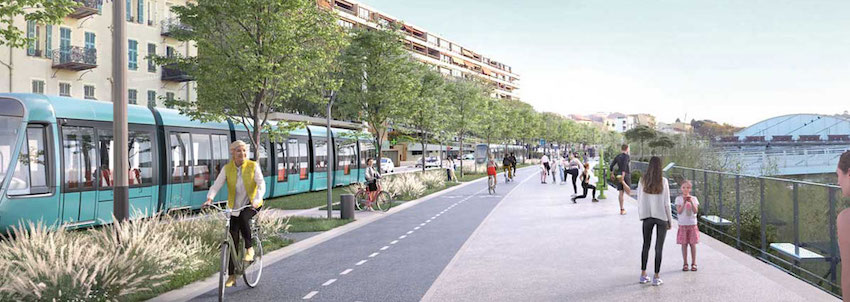
Summary of the 2030 and 2040 objectives
- Create a Metropolitan Mobility Observatory to confirm the satisfaction of your stay and your life
- Create a structuring work between Cagnes-sur-Mer and Nice Ouest.
- Join the mail in Saint-Laurent-du-Var by extending line 2 or by calling P+R
- Creation of a TCSP from L’Ariane Nord to the center-east of Nice, supplemented by a reinforcement of the offer of the existing Drap-La Trinité-Nice Thiers railway line, in connection with the South region
- Integrate the offer of Chemins de Fer de Provence into the metropolitan transport network, reinforcement of offer and desserts
- Lighten the L1 offers a complementary and alternative one on Gambetta
- Commit to the development of a contour in the center of Nice in the North
- Create the new BHNS orientations and dedicated site on the Avenue des Alpes in Cagnes-sur-Mer and in Vence, on the right bank of Carros, and on the boulevard de la Madeleine
- Creation of cable transport and route of the Var (crossings of the Var, hillsides/plain)
- Create 5,000 spaces and P+R relay parks and rides and outskirts or in the surrounding area of the heart of the city,
- Accelerate the bicycle plan, by setting up a real network of cycle routes
- Decarbonization of 100% of the bus fleet and creation of the bus maintenance center for 2025,
- Support for the development of electric mobility
Active Tramlines
Line 1: Henri Sappia to Hôpital Pasteur
Line 1, inaugurated in 2007, is the backbone of Nice’s tram network. It spans approximately 8.7 kilometers, connecting the northern part of the city to the eastern regions. The route covers 21 stations, serving key areas such as the city center, educational institutions, and residential neighborhoods.
Stops:
- Henri Sappia
- Le Ray
- Gorbella
- Valrose Université
- Borriglione
- Libération
- Gare Thiers
- Jean Médecin
- Masséna
- Opéra – Vieille Ville
- Cathédrale – Vieille Ville
- Garibaldi
- Acropolis
- Palais des Expositions
- Vauban
- Saint-Jean d’Angély Université
- Saint-Roch
- Virgile Barel
- Pont Michel
- Saint-Charles
- Hôpital Pasteur
Line 2: CADAM to Port Lympia
Line 2, operational since 2018, runs from the administrative center (CADAM) to the historic port (Port Lympia), covering a distance of 11.3 kilometers. This line significantly enhances connectivity between the western suburbs, the city center, and the eastern port area. It is also notable for including an underground section to preserve the city’s aesthetics and reduce surface disruption.
Stops:
- CADAM
- Digue des Français
- Méridia
- Les Arboras
- Le Lac
- Ouest – Stade Allianz Riviera
- Parc Phoenix
- Grand Arénas
- Nice Saint-Augustin
- Centre Européen Université
- Paul Montel – La Madeleine
- Fabron
- Sainte-Hélène
- Carras
- Ferber
- Cassin – Kirchner
- Magnan
- Grosso
- Alsace-Lorraine
- Jean Médecin
- Durandy
- Garibaldi
- Port Lympia
Line 3: Saint-Isidore to Airport Terminal 2
Line 3, which started operations in 2019, primarily serves the western part of Nice, connecting the Saint-Isidore district to the airport terminals. This 7-kilometer line plays a vital role in linking residential areas with major transportation hubs.
Stops:
- Saint-Isidore
- Digue des Français
- Méridia
- Les Arboras
- Le Lac
- Ouest – Stade Allianz Riviera
- Grand Arénas
- Airport Terminal 1
- Airport Terminal 2
Line 4: Nice – Cagnes sur Mer
Line 4 is still in the planning stages, with the aim to further extend the tram network to new areas. This line is anticipated to enhance connectivity within the metropolitan region, although specific details and stops are yet to be finalized.
Future Plan (Tentative Stops):
- Cagnes sur Mer (Parc Savaigo)
- Saint-Laurent-du-Var
- Grand Arénas
- Nice Saint-Augustin
- L’Archet Hospital
- Magnan
- Centre Universitaire Méditerranéen
- Cathédrale – Vieille Ville
- Port Lympia
Line 5: Nice – Drap
Similar to Line 4, Line 5 is part of the future expansion plans. It aims to cover areas currently underserved by public transportation, further integrating Nice’s suburbs with the city center.
Future Plan (Tentative Stops):
- La Trinité
- Bon Voyage
- Pasteur 2
- Palais des Expositions
- Acropolis
- Garibaldi
- Jean Médecin
- Thiers
- Libération
- Gorbella
- Le Ray
- Henri Sappia
Future Plans and Developments
The tram network in Nice is not only a means of transportation but also a strategic tool for urban development and sustainability. The city’s commitment to expanding and modernizing its tram system reflects broader goals of reducing carbon emissions, promoting public transportation, and improving the quality of life for residents. If you want to buy a new build construction in the Nice region along the new tramlines, you can contact us.
Line Extensions and New Connections:
The city plans to extend existing lines and create new connections to better serve growing suburban areas. This includes extending Line 2 westwards beyond CADAM and potentially integrating it with neighboring municipalities. Similarly, extensions of Line 1 and Line 3 are being considered to cover more ground and provide seamless travel across different parts of the city.
Integration with Other Modes of Transport:
A significant focus is on integrating the tram network with other modes of transport, such as buses, regional trains, and bike-sharing systems. The aim is to create a cohesive and efficient public transportation system that offers multiple options for commuters. For instance, major tram stops are being designed as intermodal hubs where passengers can easily switch between trams, buses, and trains.
Sustainability Initiatives:
Nice is investing in green technologies to make its tram system more environmentally friendly. This includes the use of energy-efficient trams, the installation of solar panels at tram depots, and the implementation of regenerative braking systems that feed energy back into the grid. Additionally, there are plans to create green corridors along tram routes with extensive tree planting and landscaping.
Improving Accessibility and User Experience:
Ensuring that the tram network is accessible to all, including people with disabilities, is a priority. This involves upgrading tram stops with better facilities, providing real-time travel information, and ensuring trams are equipped with low-floor access and spaces for wheelchairs and strollers. Enhancing the overall user experience also includes the introduction of Wi-Fi on trams, improved security measures, and the development of a mobile app for easy ticketing and travel planning.
The tramlines in Nice French Riviera represent a crucial component of the city’s public transportation infrastructure. With three fully operational lines and two more in the planning stages, the tram network is set to expand significantly in the coming years. These developments are aligned with Nice’s goals of promoting sustainable urban mobility, reducing traffic congestion, and enhancing the quality of life for its residents. As the city continues to grow and evolve, its tram system will undoubtedly play a key role in shaping its future.
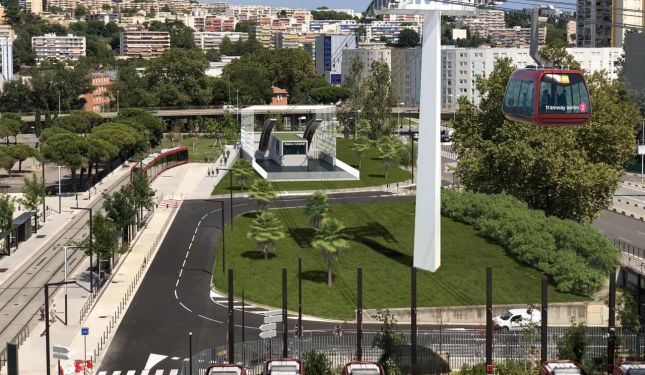
Next thing on the drawing table: cable cars!
The line that should connect the town hall of Saint-Laurent-du-Var to Cadam, in Nice, has been in the sights since a rumor of abandonment of the project circulated. The cable car that should connect two sides of the river Rives in 2 minutes and 45 seconds has been postponed to 2028. Postponed… but not abandoned.
 //
//